JOINING THE PHILIPPINE HISTORICAL ASSOCIATION

Join the Philippine Historical Association!
Educators, researchers, cultural heritage workers and other professionals who are interested in the study, teaching and promotion of Philippine history and culture, are welcome to join the PHA.

Saturday, January 8, 2011

PHA holds Teaching Rizal Seminar at The Negros Museum in Bacolod City

More than 100 teachers from Negros Occidental and Iloilo participated in the seminar.

As part of the 2010 Rizal Day celebration, the Philippine Historical Association and the National Historical Commission in partnership with The Negros Museum, held a 1-day seminar-workshop entitled "Teaching  Rizal in the Classroom: Making the Rizal Course Relevant in Our Time" on December 10, 2010 at The Negros Museum in Bacolod City.

Previous Teaching Rizal seminars were held at the Rizal Shrine in Dapitan, Zamboanga del Norte (2005), Silliman University in Dumaguete City (2006), University of San Agustin in Iloilo City (2007), and Xavier University in Cagayan de Oro City (2008).

These seminar-workshops aim to empower and equip teachers of history in making the teaching of the Rizal course more interesting and relevant.


Director Emelita V. Almosara of the National Historical Commission gave a Rizal Bust to Mrs. Lyn Gamboa as gift of gratitude for serving as host of the seminar-workshop.  
Mrs. Lyn  Gamboa, President of the Negros Museum welcomed all the seminar participants to the Negros Museum and pointed out the importance of this undertaking as an exemplary way of promoting history and cultural education in the country. 


Dr. Boncan delivering her lecture on Rizal's Ideas about Leadership and Good Governance 
Dr. Celestina Boncan (UP Manila) gave a lecture entitled "Ang Daang Matuwid Ayon kay Rizal: Rizal's Ideas on Leadership and Good Governance".  According to Dr. Boncan "Rizal left behind so many letters and literary works out of which one could draw upon the wellspring of his ideas on leadership and governance. Despite the passage of years, Rizal’s ideas on leadership and good governance remain perfectly attuned to the needs of any time period, including the present presidency of Benigno Aquino III".

Prof. Espena answering questions about controversial issues on Jose Rizal during the open forum.
Prof. Darlene Espena (Ateneo de Manila University)  delivered a lecture on  “Revisiting Controversial Issues on Rizal in Philippine Historiography”. In her lecture, Prof. Espena reminded everyone that "As teachers of history, perhaps the most important thing that we should always remember is the fact that history is interpretive and historical (absolute) truth is difficult to acquire as: facts vary/incongruent, views/ perspectives of primary historical sources vary and at the same time, the views and ideological frameworks of historians vary."

Mr. Balsamo discussing his lecture about the teaching of the Rizal Course today. 
Mr. Jonathan Balsamo (Heroes Square Heritage Corporation) presented a lecture entitled "DIS-KURSONG RIZAL:  Panimulang Pagsusuri ng mga Silabo sa Kursong Rizal". Mr. Balsamo shared some general observations and preliminary findings from his on-going study about the current trends and issues on the teaching of  the Rizal Course wherein he evaluated  Rizal Course syllabi being used in various private and public higher education institutions in the country.  

Dr. Songco discussing the Transformative Learning approach in teaching history and Rizal. 

Dr. Evelyn Songco (UST) presented an alternative way of teaching the subject Rizal using the "Transformative Learning Approach". According to Dr. Songco "Transformative Learning Approach facilitates the rational development of students by providing them with opportunities for paradigm shifts that result to affective development."

Ms. Zarah Escueta gives the audience an overview of the Rizal Shrine in Fort Santiago.
Ms. Zarah Escueta (Rizal Shrine Fort Santiago) gave a presentation entitled "The Legacy Lives On" about the Rizal Shrine in Fort Santiago. In her presentation, Ms. Escueta encouraged everyone to visit  Rizal shrines and museums as this will help us experience, understand and learn more about Rizal and his love for our country.
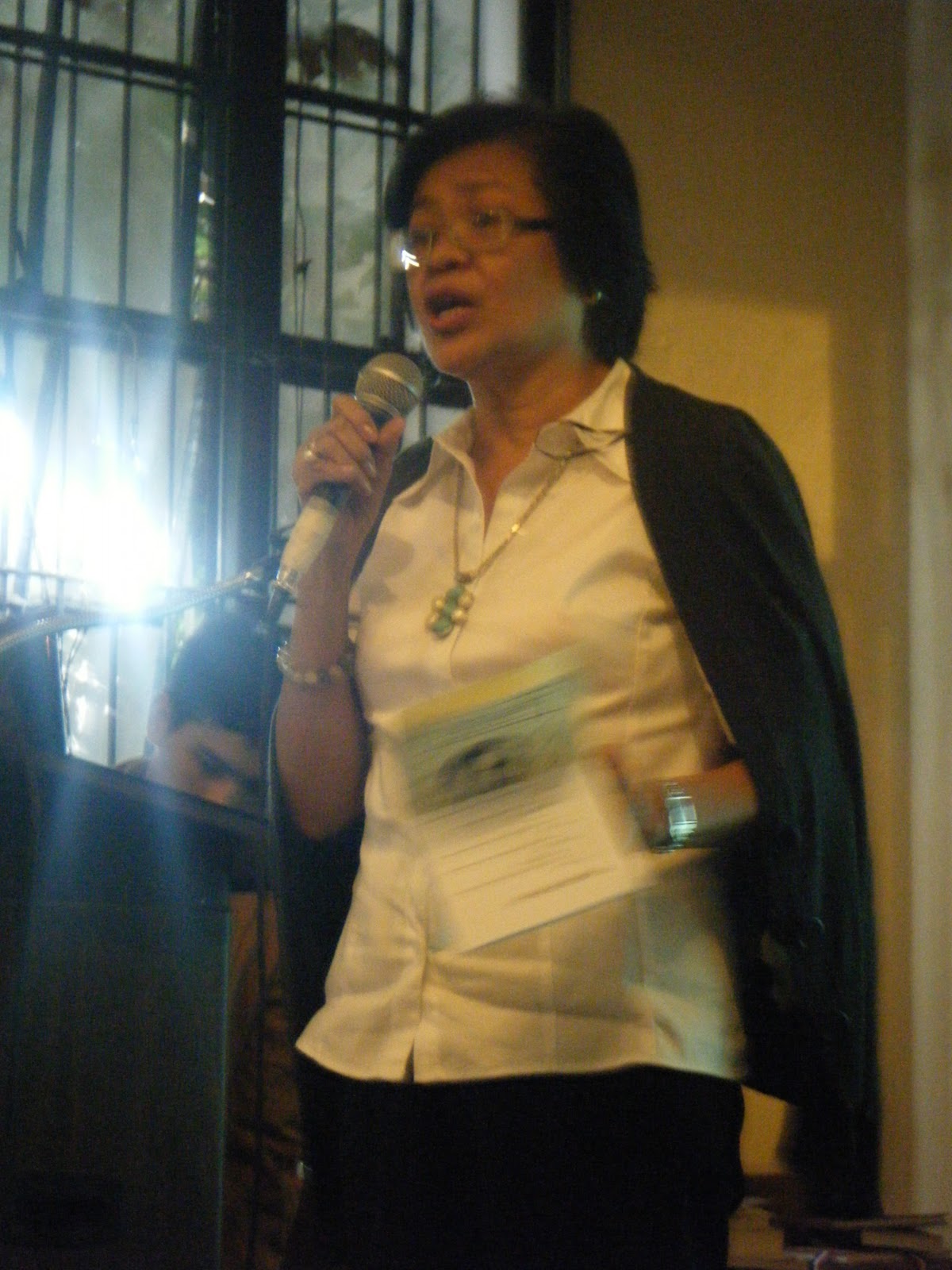
Mrs. Almosara explaining to the participants the role and programs of the National Historical Commission in propagating the ideas and heroism of our national heroes.  
Hon. Emelita Almosara, Acting Executive Director of the National Historical Commission of the Philippines, closed the seminar-workshop inspiring history teachers to give their best in teaching the history and heroism of our national heroes. She also encouraged the participants to take part in the observance of the national celebration of Rizal Day and  in the celebration of Rizal's 150th birth anniversary in 2011.


Negrense Mentors Urged to Teach Rizal with Passion
By Gil Alfredo B. Severino

"Bilib ka ba kay Rizal?"
This was the challenge of Dr. Celestina Boncan to almost 150 social sciences teachers coming from all parts of Negros Occidental, who attended yesterday’s seminar-workshop held at the Negros Museum and conducted by the Philippine Historical Association.
Boncan delivered a lecture on "Ang Daang Matuwid Ayon Kay Rizal: Reflections on Rizal’s Ideas on Leadership and Good Governance", stressing that his being a sensitive observer is worth emulating.
She added that while Jose Rizal is not a major player in the "actual" development of the Philippines in terms of leadership and Governance, his sensitivity and perception must taught with "conviction and passion" (bilib na bilib kay Jose Rizal) otherwise, "we cannot blame students for finding the subject boring".
Boncan cited that Ambeth Ocampo is an effective teacher of and writer about Jose Rizal because of his intense and profound belief in the man, Jose Rizal, and his impact to the Filipino society.
Among her printed journals, Boncan wrote about an essay of Rizal, "Sobre la Indolencia de Filipinos", where she enumerated aggravating factors leading to the decline of the Filipino enterprise, among these are the use religious superstition to solved everyday problems and other impositions of the Church, apathy of government towards commerce and agriculture, corrupt alcalde mayors, attitude of the Spaniards to despise manual labor.
All these "sensitive observation", she said, must be the conviction and passion of teaching Rizal as a subject.
Meanwhile, young Atenean professor Darlene EspeƱa, also a lecturer, cautioned teachers not to "overdo what Rizal is not".
It is quite unfortunate, she said, that people want some more from Jose Rizal, things which are no longer his person.
Dr. Evelyn Songco, President of the Philippine Historical Association, on the other hand said that there is a need to emphasize that Jose Rizal is "not from above" but rather "extraordinary".
She said for someone enjoying life abroad and to say that "He is returning to the Philippines, suffer for his people and face the consequences" is extraordinary.
An extraordinary man worth emulating and worth teaching, Songco added.Mrs. Lyn Gamboa, President of the Negros Museum, announced that the seminar-workshop will be held twice a year.*

NEGROS DAILY BULLETIN
DECEMBER 8, 2010


50 Schools Join Teaching Rizal Seminar on Friday

The Negros Museum is welcoming 125 private and public school teachers from all over Negros Occidental and Iloilo City for a free seminar-workshop entitled "Teaching Rizal in the Classroom: Making the Rizal Course Relevant in Our Time" this coming Friday, December 10, 2010 at the Museum Lobby.
This Negros Museum event is sponsored by the 2010 Rizal Day National Organizing Committee, the National Historical Commission and the Philippine Historical Association.
Lecturers will be Dr. Celestina Boncan (University of the Philippines-Manila), Prof. Darlene Machell EspeƱa (Ateneo de Manila University), Prof. Jonathan Balsamo (Heroes Square Heritage Corporation/Enderun Colleges), Dr. Evelyn Songco (University of Santo Tomas) and Ms. Zarah Escueta (Curator, Rizal Shrine Fort Santiago, Intramuros).
Aside from important lectures about Jose Rizal and teaching Rizal, this one-day event program is packed with mini-workshops like "Arts in Teaching History" and "Creating Learning Experiences in the Study of Rizal’s Life and Writings".
Negros Cultural Foundation and Negros Museum President Lyn Gamboa will also welcome special guests Dr. Evelyn Songco, President of the Philippine Historial Association and Emelita Almosara, Acting Executive Director of the National Historical Commission.
More than 50 private and public schools and colleges in Negros Occidental and 3 Iloilo universities are expected to take advantage of this free seminar-workshop for their teachers.
As of press date, the museum has already reached maximum number of participants allowed by the organizers and would like to advise other interested parties to contact the museum for other event updates. Your local museum is also open to suggestions and requests for seminars or workshops you or your organization may want to attend in the future. Please contact 09173007742 and 431-9451 / 708-5080.*

PHA would like to thank THE NEGROS MUSEUM for hosting the seminar-workshop particularly Ms. Tanya Lopez and Ms. Tata Sevilleno --- Maraming salamat po!

Friday, January 7, 2011

The PHA 2010 National Conference

Philippine Historical Association 2010 Annual Conference and 55th Founding Anniversary


Dr. Pablo Trillana III, past president of PHA and incumbent Supreme Commander of the Knights of Rizal, talked about "Rethinking Rizal, Rethinking Filipinos"


Thursday, January 6, 2011

PHA VICE PRESIDENT ANNOTATES RIZAL DAY 2010 OFFICIAL COVERAGE

XIAO ANNOTATES RIZAL DAY 2010 OFFICIAL COVERAGE


(Posted by Jonathan Balsamo from Xiao Chua's facebook)

"Kararating ko lamang para sa panatang pagtungo sa pagdiriwang ng Araw ni Rizal nang bigla akong hilahin ng staff ng NBN-4 upang makibahagi sa kanilang opisyal na coverage ng mga pangyayari sa Luneta.  Windang pa ako pero nagpapasalamat pa rin ako sa pagkakataon na makibahagi sa napakahalagang okasyon na iyon."


Ang opisyal na coverage ng Pambansang Network at ng Radio TV MalacaƱang sa pagdiriwang ng ika-114 na Kabayanihan ni Dr. Jose Rizal, Pambansang Bayani ng Pilipinas at pagsisimula ng isang taong pagdiriwang ng ika-150 na Kapanganakan ni Dr. Rizal (RIZAL @ 150) sa 2011 na may temang "Rizal:  Haligi ng Bayan."  Ang pagdiriwang ay pinangunahan ng walang iba kundi ang Pangulong Benigno Simeon "Noynoy" Aquino, III (ang kanyang unang Araw ni Rizal) kasama ang Pangalawang Pangulo Jejomar "Jojo" Binay, Alkalde ng Maynila Alfredo "Fred" Lim, at Acting Executive Director ng Pambansang Komisyong Pangkasaysayan ng Pilipinas (NHCP) Emelita "Mely" Almosara, CESO.

Ang komentaryo ay nagmula sa mamahayag na si Kathy San Gabriel at mula kay Michael Charleston "Xiao" Chua, historyador na nagtuturo sa Pamantasang De La Salle Maynila at Pangalawang Pangulo ng Philippine Historical Association.


Ang contingent ng Philippine Historical Association sa Pagdiriwang ng Araw ni Rizal 2010: Pangalawang Pangulong Michael Charleston "Xiao" Chua, Immediate Past President Celestina "Cely" Boncan," PRO Jonathan "Jobal" Balsamo, at Pangulong Evelyn Songco (Mula sa FB ni Jonathan Balsamo)


ANTHONY TABERNA INTERVIEWS PHA'S JONATHAN BALSAMO ON RIZAL DAY!


http://www.youtube.com/watch?v=Hp2jQWH0zNA

Panoorin, sa kagandahang loob ni Mark B. Chua ang panayam sa programang Iba-Balita ng Studio 23 ni Anthony Taberna kay G. Jonathan Balsamo, PRO ng Philippine Historical Association noong gabi ng 30 Disyembre 2010.

Thursday, December 2, 2010

Teaching Rizal Seminar at The Negros Museum, Bacolod City

THE NEGROS MUSEUM in Bacolod City will host the annual “Seminar-Workshop on Teaching Rizal in the Classroom: Making The Rizal Course Relevant in Our Time" on December 10, 2010, as part of the national celebration of Rizal Day 2010.

Speakers include: Dr. Celestina Boncan (UP Manila)  on "Ang Daang Matuwid Ayon kay Rizal: Reflections on Rizal’s Ideas on Leadership and Good Governance"; Prof. Darlene Espena (Ateneo de Manila University) on "Revisiting Controversial Issues on Jose Rizal in Philippine Historiography"; Mr. Jonathan C. Balsamo (Enderun Colleges) on "“DIS-KURSONG RIZAL: Pagsusuri ng mga Silabo sa Kursong Rizal"; Dr. Evelyn Songco (University of Santo Tomas) on "Using Transformative Learning in Teaching Rizal"; and Ms. Zarah Escueta (National Historical Commission) on "Rizal Shrine Fort Santiago: The Legacy Lives On".

This will be the fifth of the series of seminars organized by the Philippine Historical Association and the National Historical Commission for the celebration of Rizal Day. Previous seminars were held in  Rizal Shrine in Dapitan City (2005), in  Silliman University in Dumaguete City (2006), in University of San Agustin in Iloilo City (2007), and in Xavier University, Cagayan de Oro City (2008).

This is also in line with the museum’s Continuous Education Program, Workshops and Seminar to provide venues of staff development and training to individuals and organizations in the province and nearby provinces.

Limited slots available. This is for FREE. Please pre-register at the museum on or before 5pm of December 9, 2010.

Interested schools and teachers may contact The Negros Museum, 09173007742 or 4334764 or email at negros_museum96@yahoo.com for more information. The organizers can send official communication to your school upon request.

Visit: http://negrosmuseum.blogspot.com/2010/11/teaching-rizal-seminar-workshop-at.html

Sunday, October 31, 2010

Ambeth Ocampo: One Unconventional Teacher


Ambeth Ocampo with history teachers from the Western Visayas region during the PHA Regional Seminar on Teaching Rizal at the University of San Agustin in 2008.


One Unconventional Teacher
By RACHEL C. BARAWID
October 27, 2010, 11:12am
Manila Bulletin
MANILA, Philippines – When he talks, everyone intently listens and hangs on to every word he says.
National Historical Institute (NHI) chair Ambeth Ocampo is no hotshot actor nor a shining pop star. But to many of his students, he is that excellent history teacher that every learner dreams of having.
A writer and a historian, Ambeth is first and foremost a teacher. He teaches the Rizal course to junior college students at the Ateneo de Manila University (AdMU) twice a week, and once a week at the University of the Philipines. It is not rare that his classes are held at the auditorium of the Ateneo, jampacked as they are. Yet it is amazing how Ambeth is able to connect to each student and create the desired impact.
MENTORED BY THE BEST
Ambeth admits that he wasn’t a stellar student. But he was lucky to have been mentored by the best people in the industry, among them Doreen Fernandez, Teodoro Agoncillo, and Letty Jimenez-Magsanoc.
He says Doreen Fernandez taught him English and Philippine themes, Agoncillo gave him a crash course in history, and Magsanoc helped him hone his writing. Entertainment editor Ricky Lo, whom he sat next to when he was just starting his career in journalism, also had an influence on Ambeth and his writing.
“My degrees came from De La Salle University but my undergrad was from Ateneo. I went to all three universities, UP is the third. I wasn’t a stellar student but I was fond of history already,” reveals the 49-year-old Ten Outstanding Young Men (TOYM) awardee for history in 1997. “That’s why in the beginning, I presented history to the reader in a different way – fun, gossipy and engaging. But academic historians were upset with me because of this. Sabi ko, the sources are primary, it’s just that the presentation was not academic. I have academic works which nobody reads. Why would you use an academic yardstick for a popular thing? To this day, I continue to give a light touch to my column.”
THE GREAT SLIDESHOW
Anyone who has become Ambeth’s student could attest to the fact that the showing of the “Great Ambeth Ocampo Slideshow” is the most awaited time of the semester. This is actually Ambeth’s presentation of Dr. Jose Rizal’s life in pictures.
“I’ve been showing it for 30 years now when a few years ago, one of my students raised her hand and said that the famous drawing of Leonor Rivera is not her. I said ‘Why who do you see?’ ‘That’s Michael Jackson after cosmetic surgery.’ Of course I laughed! But if you’re a normal teacher you’d say ‘shut up, that’s a stupid comment’ di ba,” he recalls.
Such humor has certainly endeared Ambeth to his students. He admits he is the “performer type’’ who would use humor to get his message across to his students.
“Some are wondering how Ambeth Ocampo, who talks in a monotone, can hold a class for hours. I keep on telling many teachers, my pedagogical method is that way because when students laugh, all their defenses are down and that’s the best time to get a message across. It works very well. You also have to know your material and make it relevant to them. History is relevant because you have to find a hook, a way in which to link the past and the present. So you have to watch TV shows, cable TV.
That’s the only way you can find a connection. To be good in history, you also have to be updated,” he stresses.
MAKING HISTORY EXCITING
Ambeth’s students also look forward to his field trips to historical destinations. When he was younger, Ambeth would bring his classes to Intramuros to see San Agustin Church, where Juan Luna was buried, and other interesting pieces of history.
Today he does not go with his many students anymore but he requires them to go on their own or with their friends to make learning more fun.
To make his lessons more relevant, appealing and exciting, Ambeth has also set up a blog where students may share their experiences after the field trip and post pictures.
Ambeth doesn’t use prescribed textbooks and instead uploads different readings, that include even literature and prose. Students may access it on his site and read it at home. He also holds online discussion with his students through the Yahoo e-groups and Facebook.
“There’s no reason to be uninteresting. The Internet has so many things. I’m allergic to chalk so I have PowerPoint, these social networking sites and more. It really helps but in the end, if you have nothing to teach, wala talaga. The PowerPoint is just a tool, it doesn’t replace your teaching, it just allows them to see things in a different way,” he points out.
THE OTHER JOB OF A TEACHER
Ambeth says he has also become more than a teacher, but a friend and confidante to his students.
“I am not touchy feely but there were a number of suicides last year, three of them are my students. So minsan nag iisip ako ako ba ang may kasalanan nun. One student of mine went to Spain and even brought home a Bible for me. Two weeks later, he committed suicide. I learned from his mother that I was one of his favorite teachers and talked about me most of the time when he comes home from school. So they looked forward to those days when he would recount what I told him in class, his parents learning from the lessons as well. This incident made me become more open to my students. I monitor their grades now and ask them if they have problems when their grades are going down. Kasama na talaga sa trabaho ng isang teacher ito,” he discloses.
Ambeth has received so many national and international recognitions already, the latest being The Many Faces of a Teacher award by the Bato-Balani Foundation. While it may be just another feather in his cap, Ambeth is proud of this recognition because he is acknowledged for being a teacher.
“I do so many things. I write for a newspaper, I’m chair of the NHI. But all of that is part of being a teacher. Teaching is the primary concern, everything that I do is basically teaching,” he notes.
Ambeth’s father was a former teacher at the UP College of Engineering who had to leave his profession to earn a living. The senior Ocampo was also a frustrated writer. So Ambeth says he is happy to be fulfilling all the dreams his father had for himself.
“I always tell people that the reason why I teach is because I learn so much more from the students than they learn from me. You see how they understand things, you have a sense of actually changing a life. It changes over time. I think that’s why teachers remain young because they’re connected with young people. Tignan mo yung magagaling na teachers kahit matanda na sila, there’s still a sense of youth in them. So in a sense, teaching is rejuvenating for us,” Ambeth ends.